
What happened to TestYourVocab.com?
If you looked for an English vocabulary test any time in the 2010s, you probably ended up on a bright yellow page that asked a simple question: how many words do you know? That was TestYourVocab.com, and it's the reason our test exists.
A test that was also a research project
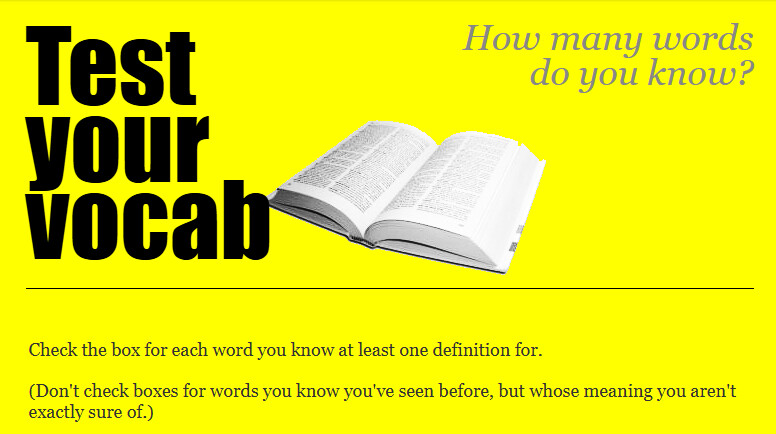
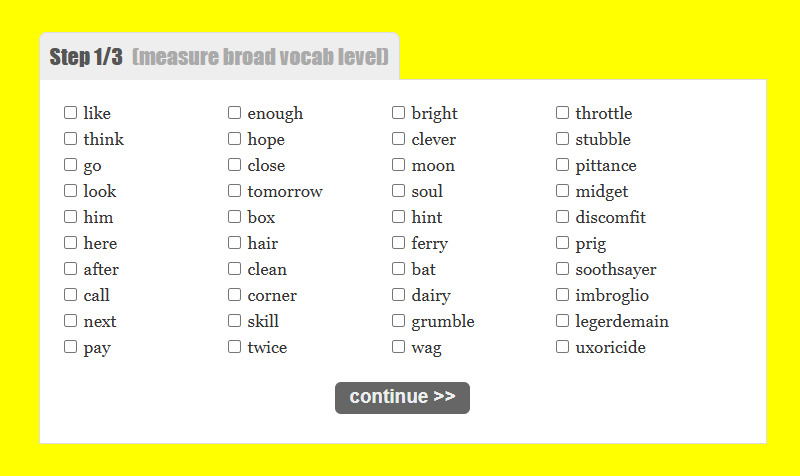
TestYourVocab was built around 2010 as "an independent American-Brazilian research project to measure vocabulary sizes according to age and education". The test itself was quick and clever. The first step showed 40 words, from "like" and "think" to "imbroglio" and "uxoricide", to find your rough level. The second showed around 120 words chosen around that level, to pin it down. You just ticked the words you knew.
The third step was what made it special: an optional survey about your age, education, reading habits and how you learned English. Millions of people filled it in. By May 2013 the test had been completed more than two million times, and the authors published what they had found:
- Most adult native speakers who took the test knew between 20,000 and 35,000 words.
- Native-speaking children knew about 5,000 words at age 4 and 10,000 by age 8.
- Adults kept learning almost one new word a day until middle age, and then mostly stopped.
- The most common result for learners of English was about 4,500 words.
- Learners who lived in an English-speaking country picked up around 2.5 new words a day, and usually passed 10,000 that way.
- For native speakers, reading as a child, fiction especially, mattered more than anything else.
These findings were quoted everywhere, from language forums to newspapers, and they still hold up well against later research. You can still read their summary of results on the Internet Archive. Not bad for a small independent project with a yellow background.
Its weak spot: taking people at their word
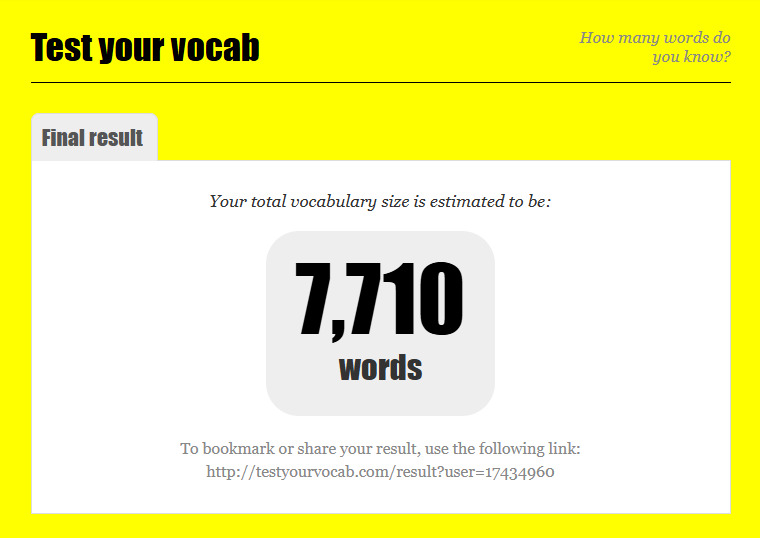
A checklist test has one big problem: people tick words they don't really know. Not out of dishonesty, usually. A word that looks familiar feels known. TestYourVocab had no way to catch this. Its FAQ asked "How do you make sure people aren't cheating?" and answered, honestly, "We try". Its hope was that over-ticking would affect everyone about equally, so comparisons between groups would still work.
For averages across millions of people, that was a reasonable bet. For your own result, it meant the number was only as good as your restraint.
What happened to it
By spring 2022, TestYourVocab had been taken over by Preply, an online tutoring company. In our view, it's a sad end for one of the best things on the language-learning internet.
Every address on the old site now redirects to a single page on preply.com. The blog, with years of findings from millions of people, is gone; the only copies left are on the Internet Archive. The survey that produced those findings is gone too. The test now has two steps instead of three, and nothing new is being learned from the people who take it.
What's left is a test frozen in time and wrapped in sales. Its FAQ still quotes figures about the site's early test-takers from more than a decade ago, like their average SAT score. It still has no way to catch people who tick words they don't know, the one weakness the original never got to fix. And the page around it is now mostly about selling lessons: "Find a private tutor", tutor profiles, and buttons to book trial lessons at $39 to $65 each. The test seems to work much as before, but the page now feels like a sign-up form for tutoring.
TestYourVocab was a research project that also happened to be a great test. Preply kept the test and threw away the research. We think that's a waste.
What we took from it, and what we do differently
We built TestVocab because we missed the old TestYourVocab. The basic idea is the same: tick the words you know, and the test estimates the rest from a sample across the language. A few things are different:
- Made-up words. Some words in our test don't exist. Ticking them tells the test how freely you're ticking, and your result is adjusted for it, more for each one. This is our answer to "how do you make sure people aren't cheating?". There's more on this in why our test includes words that don't exist.
- A checked word list. We went through our words one by one and removed the ones that don't belong in a general test: specialist jargon, foreign words and odd forms of other words.
- Open statistics. Our statistics page shows average results by country from everyone who has taken the test, updated as new results come in. It shows how uncertain each number is, too.
- An explained method. The methodology page explains how the estimate is made, with charts.
- Free, in 17 languages, no sign-up. The instructions and results are available in 17 languages, and there's nothing to buy.
We're much smaller than TestYourVocab was at its peak: just over 7,000 results from 116 countries so far, against their two million. But every one of them goes into the statistics, and we'll keep publishing what we find.
TestYourVocab showed that a simple checklist, taken by enough people, can tell us a lot about how vocabulary grows. We're grateful to the people who built it, and we're trying to keep that spirit alive. If you remember the yellow page, give our test a try and see how your number compares.
